Decentralized Confidential AI Inference Powered by Smartphones
Acurast, Pocket Network and NodeGhost: Exploring decentralized confidential AI inference powered by smartphones
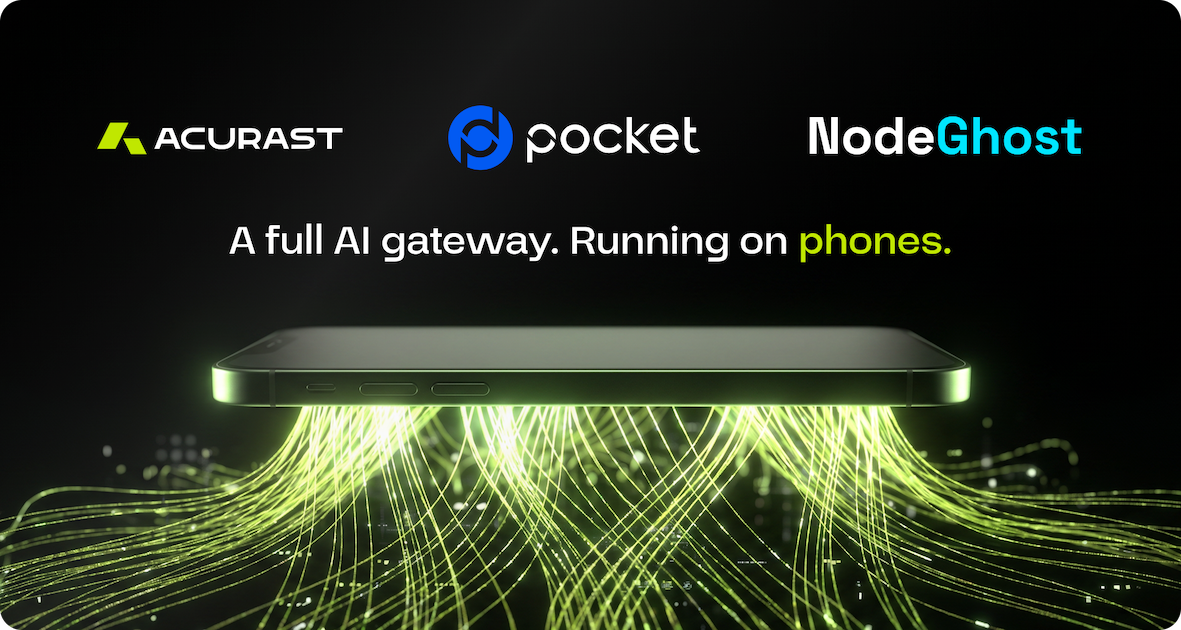
Acurast, Pocket Network and NodeGhost have been running an early experiment together to see what a fully decentralized AI stack looks like in practice. Three protocols, each handling a different layer: Acurast provides the decentralized compute, Pocket Network provides the decentralized routing, and NodeGhost provides the developer-facing AI gateway that ties it together.
The first results are promising. Over an hour-long test, NodeGhost packaged its gateway logic into one Cargo build covering both AI inference relay and web search, then sent a request every 30 seconds mixing the two. Every request landed, with none dropped across the run.
To our knowledge, this is one of the first times a full AI gateway has run entirely on TEE-secured smartphones, with no traditional cloud server anywhere in the pipeline.
This is an exploratory collaboration, nothing set in stone yet, but the shape of it is worth sharing.
Early experiment
A full AI gateway on phones
Inference and web search, an hour of sustained traffic, zero dropped calls.
What NodeGhost tested on Acurast
NodeGhost packaged its entire gateway logic into a single Cargo build and ran it directly on Acurast’s attested Android devices. The bundle included both inference relay and web search, which suggests a full-featured AI gateway can run on phone hardware inside a Trusted Execution Environment.
The test ran for a full hour. A request went out every 30 seconds, alternating between inference calls and web searches, and the system handled all of them without a single failure.
What stood out for the NodeGhost team was how naturally the pieces fit together. Before they found Acurast, they had been working toward the same problem from the other side. They had the routing layer covered through Pocket Network but had not found a compute layer that fit. Acurast filled that gap. It was, in their words, exactly the kind of infrastructure their service was designed to run on.
Note: NodeGhost’s gateway runs as a Cargo container, which executes on attested Android devices in the Acurast network. iOS-based Acurast Processors continue to participate in JavaScript workloads as before.
Why this matters
It is an early signal that Acurast’s smartphone compute layer can handle real, sustained AI workloads. The gateway logic executes inside hardware-level Trusted Execution Environments, so the code runs confidentially and cannot be tampered with, not even by the device operator.
NodeGhost did not modify its architecture or compromise on functionality to run on Acurast. It compiled, ran, and behaved exactly as intended.
“It compiled, ran, and behaved exactly as intended.”
Where Acurast comes in
Acurast provides the compute infrastructure behind the test. Rather than renting servers from hyperscalers or any centralized provider, NodeGhost’s gateway ran on Acurast’s global fleet of 260,000+ smartphones across 175+ countries. Each device is secured by a hardware Trusted Execution Environment that ensures confidentiality, integrity, and attestation of every workload.
For AI inference specifically, the architecture brings a few real advantages:
Globally distributed
The network places compute close to end users, which reduces latency.
Protected at the hardware level
Workloads are shielded at the hardware level, not just in software, so even sensitive AI requests are protected from observation or tampering.
Scales horizontally
Because Acurast runs on consumer smartphones rather than data center hardware, the network grows as more phones join, without the capital expenditure of centralized cloud infrastructure.
This early run suggests Acurast is not limited to lightweight tasks. A full AI gateway handling sustained inference and web search traffic is a meaningful workload, and the network carried it without a single failure across the testing period.
How NodeGhost operates on Pocket Network
NodeGhost is a decentralized AI inference gateway live on Pocket Network’s Shannon mainnet. It gives developers a drop-in replacement for the OpenAI API, same interface and same compatibility, except every request routes through Pocket Network’s decentralized relay infrastructure instead of a corporate data center.
Pocket Network is a decentralized marketplace for open data access. When NodeGhost sends a request through the protocol, it routes across thousands of independent node operators worldwide. Suppliers are assigned to sessions through deterministic, manipulation-resistant algorithms, with no central scheduler and no single point of failure. Every relay is cryptographically verified on-chain, and suppliers stake POKT tokens as a quality guarantee.
What this means
Together, these three protocols form a fully decentralized AI stack from the ground up. Acurast replaces the centralized cloud with a global network of TEE-secured smartphones. Pocket Network replaces centralized API routing with a blockchain-verified relay marketplace. NodeGhost replaces the centralized AI gateway with a privacy-first, permissionless inference service that never logs prompts or responses.
No single company controls the compute, the network, or the data at any point in the pipeline. In principle, that means AI inference through a familiar OpenAI-compatible API, at a fraction of the cost of centralized alternatives, with verifiable guarantees that no entity can monitor or censor the traffic.
These are early results, not a finished product, but they are a concrete first step. We are keen to keep exploring what is possible together as both networks continue to scale.
260K+
Phones
175+
Countries
1 hour
Sustained test, zero drops
About NodeGhost
NodeGhost is a decentralized AI inference gateway live on Pocket Network’s Shannon mainnet. It offers an OpenAI-compatible API that routes AI requests through a decentralized network with no centralized logging, no surveillance, and no single point of failure. NodeGhost supports Bring Your Own Model deployments and offers inference, web search, and vector memory through a single API with flat, predictable per-relay pricing. Read more at https://nodeghost.ai
About Pocket Network
Pocket Network is a decentralized infrastructure protocol that matches applications needing data access with independent suppliers who provide it. The protocol handles session assignment, relay routing, cryptographic verification, and economic settlement without a central coordinator. With over 5,000 global node operators and billions of relays served to date, Pocket Network’s Shannon mainnet is built for high-throughput workloads including AI inference. Read more at https://pocket.network
About Acurast
Acurast is a decentralized physical infrastructure network (DePIN), a global fleet of smartphones providing distributed, secure edge compute. Acurast redefines decentralized compute with smartphones, battle-tested devices trusted by billions. With Acurast, AI/ML inference workloads can be securely deployed to a global network of 260,000+ attested edge devices across 175+ countries, enabling privacy-preserving tasks close to data sources through hardware-level Trusted Execution Environments. Read more at https://acurast.com