Reliable Compute, Powered by Staking
Acurast connects real phones with real incentives, turning smartphones into a global network of trusted compute.
Parameters may evolve. For details, see Documentation.
See it in 60 seconds
Parameters may evolve. For details, see Documentation.
STAKING WITH ACURAST
Why Staked Compute Matters
Developers who are building on Acurast compute seek high performance and rely on uninterrupted service. In decentralized networks, reliability can’t be assumed, it has to be proven. Staked Compute sets incentives for sustainable and continuing compute power. Providers contribute real phones; delegators reinforce them by staking their tokens.
The result is a network that stays active, is backed by accountability and ready to run workloads continuously.
How Staked Compute works
How It Works
Onboard a phone or buy ACU
Providers (Committers) onboard their phones (*Lite or Core) and start providing compute. Delegators start with ACU they will be able to buy on an exchange once available.
*For staking the phone should be online 24/7 and ideally you have multiple phones.
Connect your phone in the Hub

Stake Tokens
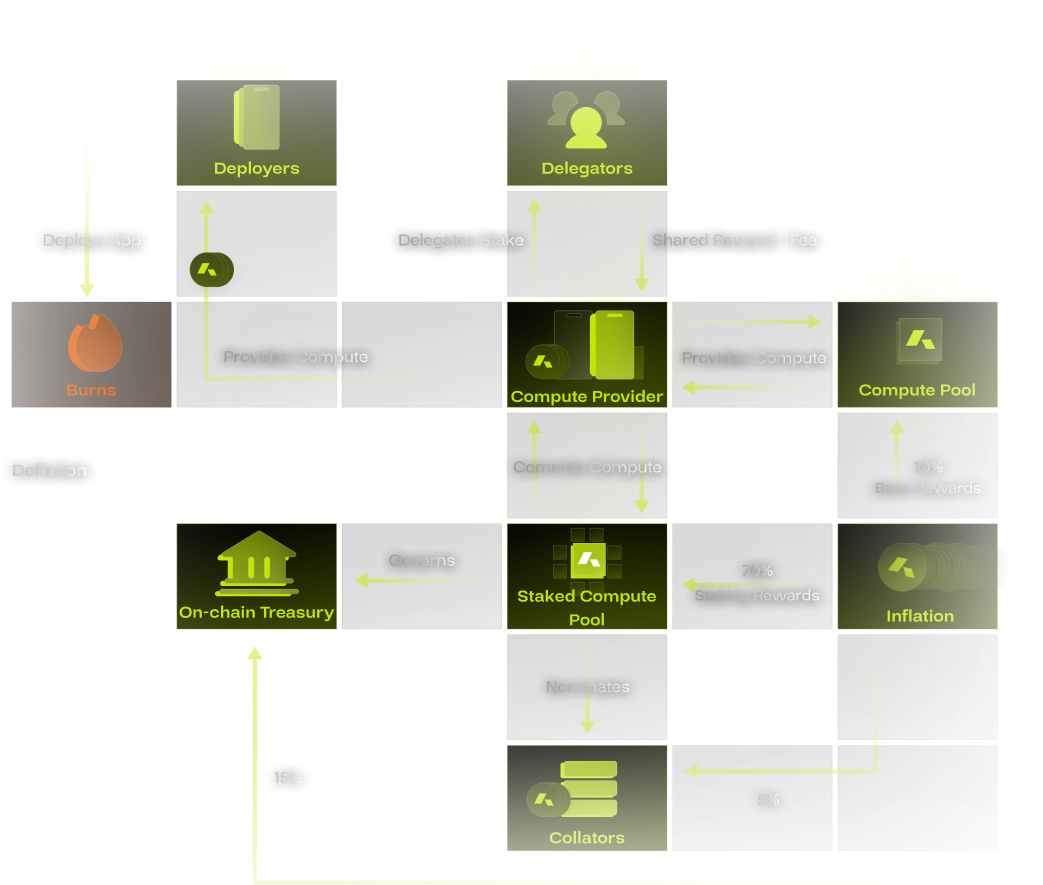
Committers lock their tokens against a promised compute amount. Delegators choose a committer and lock their tokens to take part in their stake.
Stake Tokens

Run and stay reliable
Benchmarks and heartbeats verify the staked compute amounts and liveness. Rewards are aligned according to performance, compute percentage, token amount and time. Delegators will get a share from the rewards from Committers.
Open Acurast Hub
Onboard a phone or get ACU
Providers (Committers) onboard their phones (*Lite or Core) and start providing compute. Delegators start with ACU they will be able to buy on an exchange once available.
Connect your phone in the Hub*For staking the phone should be online 24/7 and ideally you have multiple phones.
Stake Tokens
Committers lock their tokens against a promised compute amount. Delegators choose a committer and lock their tokens to take part in their stake.
Stake TokensRun & Stay Reliable
Benchmarks and heartbeats verify the staked compute amounts and liveness. Rewards are aligned according to performance, compute percentage, token amount and time. Delegators will get a share from the rewards from Committers.
Open Acurast Hub
Two roles, one network.
Committers & Delegators
Commiters
Provide real hardware (smartphones / farms).
Keep phones live and replace capacity as needed.
May add their own stake and can accept delegations.
Share rewards with delegators.
Delegators
Don’t run hardware; they contribute to a stake with their tokens.
Select committers and support reliable compute providers.
Get reward share from committers.
Can redelegate at any time.
Reliability has value
Reliability & Accountability
Phone performance and uptime are verified on-chain. If a committer underdelivers their promised compute, their stake can be reduced, aligning incentives with accountability. When unstaking, a cooldown period slows reward accrual but responsibility to maintain committed compute remains until it ends. This keeps the network stable for everyone.
Reliability has value
Rewards & Auto-Compounding
Rewards are distributed each epoch and scale with three factors: committed compute, token amount and cooldown period.
Enable auto-compounding to keep rewards productive, restaking them automatically to sustain capacity.
Acurast Reward Formula
Committed Compute
Stake Amount
Cooldown period
Aligned incentives. Real Reliability.
Why It Matters
The Bigger Picture
Phones itself are not accountable, users are. Staked compute ensures network stability, holds providers accountable and rewards them if they stake and keep their promise.
Go to the Staking Hub
Go to https://hub.acurast.com/staking and start with “Stake Compute”.
Fill in the parameters
Fill in the staking parameters according to your preferences.
Start your stake
Review your setup and start your stake once everything looks correct.
Monitor your stake health
Monitor your stake health to ensure your commitment is kept.
Collect rewards
Collect rewards from your active stake as they accrue.
Get ACU
Get ACU from an available exchange.
Withdraw to your EVM wallet
Withdraw your ACU to your preferred EVM wallet.
Connect to the Acurast Hub
Connect your EVM wallet to the Acurast Hub.
Bridge to native ACU
Bridge your EVM-ACU to native ACU on the Hub.
Create a delegation
Create a delegation and choose your preferred committer.
Collect rewards
Collect rewards from your delegation.
Network Parameters
Key parameters
Epoch cadence
900 blocks (~1.5h)
Reward source
Protocol inflation: 5% per year
70% to Staked Compute pool
Benchmark weights
RAM (0.4615), CPU single (0.2307), CPU multi (0.2307), Storage (0.0769)
Slashing
Proportional stake reduction for underperforming. Maximum slash rate: 0.003424657534% of the stake per epoch
Mainnet vs Canary
Canary Cooldown: 6 hours to 48 days
Mainnet Cooldown: 28 days to 1344 days
Frequently Asked Questions
Below are the most frequently asked questions.
What is the Cooldown period?
When a stake is created, the Committer or Delegator chooses a cooldown length. The allowed range differs between networks: on Mainnet, cooldown periods range from 28 days to roughly 3.68 years, while on Canary, they range from 1 hour to 48 hours. When the user decides to unstake, they trigger the cooldown countdown. Only when the cooldown has ended can they withdraw their staked tokens. During cooldown, the reward weight and vote weight are reduced to 50% of the previous value. See the Mainnet vs. Canary comparison for exact block values.
What is the reason for the Cooldown Period to exist?
The cooldown period protects the network from sudden losses of compute capacity. Without it, committers could instantly withdraw their stakes and shut down their hardware, leaving the network vulnerable to instability. The cooldown gives the network time to adjust and allows other providers to fill the gap. It also ensures that committers remain committed to their promise: during cooldown, they must continue maintaining their full committed compute (with full slashing risk) even though their rewards are reduced to 50%. This design discourages impulsive exits and rewards long-term commitment, which is essential for building a reliable, predictable compute network that developers and users can depend on.
What are Risk/Reward Tradeoffs of Staking with Acurast?
Staking with Acurast follows a clear principle: higher commitment equals higher rewards, but also higher risk. Committers who commit more compute, stake larger amounts of tokens, and choose longer cooldown periods earn proportionally greater rewards – but they also face greater slashing penalties if they fail to maintain their committed compute levels. For example, committing 80% of your measured compute yields more rewards than committing 50%, but falling short on that 80% commitment results in larger slashing penalties. Delegators face a similar tradeoff: they can earn staking rewards without running hardware, but they share in their chosen committer’s slashing risk. The key is finding the right balance – commit what you can reliably maintain over the long term. Conservative commitments (lower compute percentage, shorter cooldown) offer lower rewards but also lower risk, while aggressive commitments maximize rewards but require consistent, reliable operation of your hardware.
Why do I only see one slider to Commit Compute, when the four metrics are treated separately anyway?
Even though any stake is basically a separate committement for each of the four of the benchmark pools (CPUs, CPUm, RAM, Storage), the staking frontend only shows one slider for simplicity reasons. For example, if the Committer selects to stake 50% of the measured compute, his stake is a committment to keep up 50% of the compute per Benchmark Metric Pool. Means to upkeep 50% of the CPU Single Core Benchmark Metric, 50% of the CPU Multi Core Benchmark Metric, 50% of the RAM Benchmark Metric and 50% of the Storage Benchmark Metric over the lifetime of the stake.
Why can I only commit 80% of my measured Compute?
The maximum a user can commit is capped at 80% of the currently total measured compute, in order to prevent early Slashings if the Committer’s Compute is fluctuating due to processors going offline.
Why can I only stake 999 tokens if I have 1000?
When a user stakes tokens, all of these tokens will be locked and cannot be moved. This means that the users account won’t be able to pay for gas fees caused by processors to report heartbeats and deployment execution reports. This would result in a situation where this account won’t be able to receive rewards from benchmarks or computation without getting additional tokens. Therefore a safeguard deposit of 1 cACU / ACU was introduced.
What is the maximum of tokens a user can stake?
A committer can stake as much as they want up to the limit defined by their compute metric × the allowed ratio. The higher their benchmark (more or stronger devices), the more stake they can back it with. The committer’s own stake cannot exceed some multiple of their compute metric capacity (benchmark score). This prevents someone from locking an enormous amount of ACU behind a tiny phone and unfairly capturing rewards.
How much in rewards can a Committer or Delegator expect?
Staking rewards in the Acurast network are dynamic and cannot be precisely predicted in advance, as they depend on the collective behavior of all participants. Your individual rewards are determined by your share of the total network commitmen – calculated from your benchmark scores, stake size, and cooldown duration relative to all other stakers. As more participants join with varying parameters, or as existing participants adjust their commitments, the reward distribution shifts accordingly. Additionally, rewards are split across four separate benchmark metric pools, meaning your performance in each metric directly impacts your share of that pool’s rewards.
Once the system goes live and staking activity stabilizes, estimated Annual Percentage Rates (APR) will become available to help participants gauge potential returns. However, the fundamental principle remains: stronger hardware, larger stakes, and longer commitment periods will always yield proportionally higher rewards compared to participants with lower commitment levels.