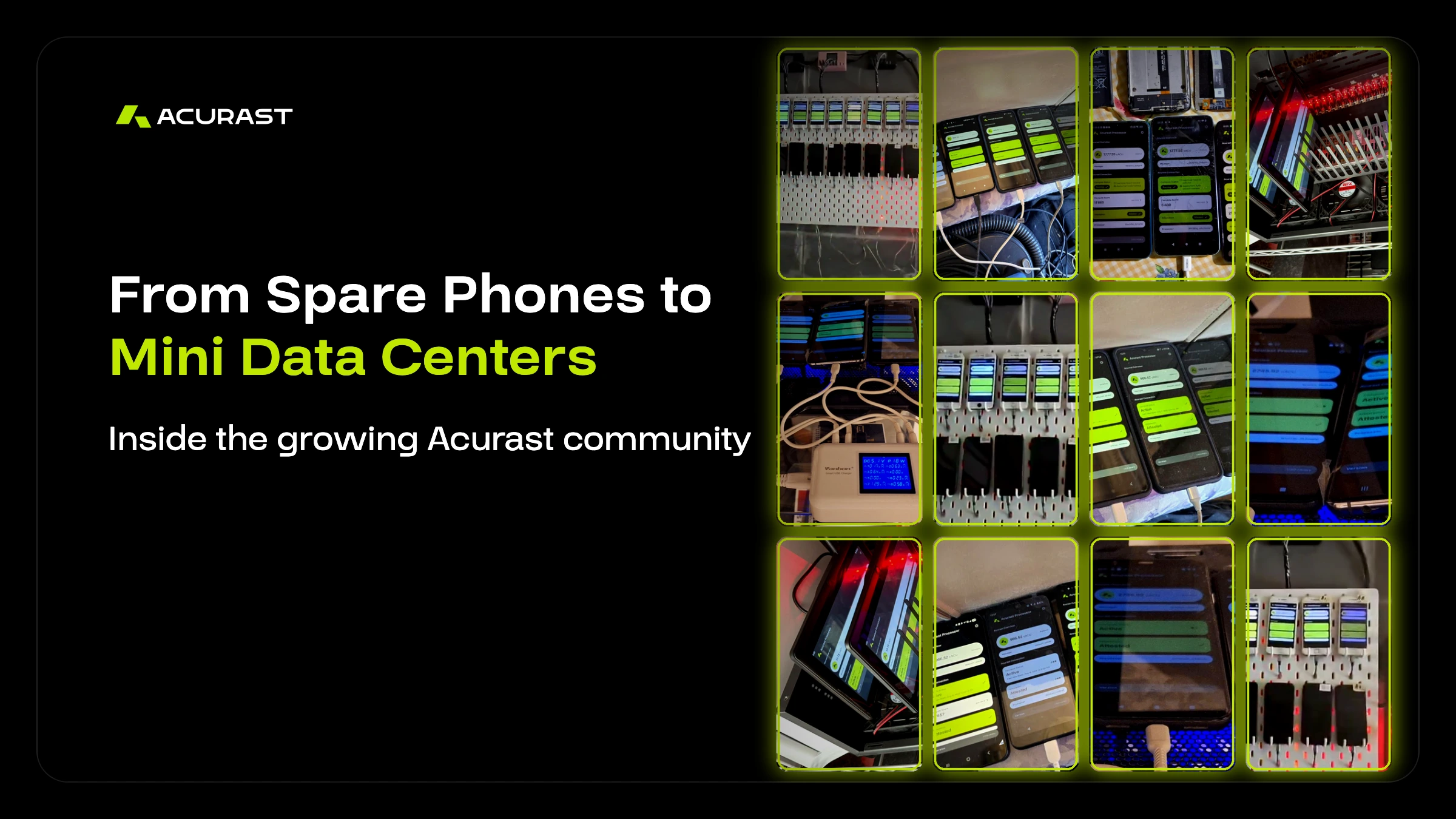
From Spare Phones to Mini Data Centers: Inside the Growing Acurast Community
Every network starts with technology. But technology alone does not build a network.
People do.
Across the Acurast community, members are getting more and more creative with their setups, adapting the hardware to their own space, budget and needs. It always begins with a single phone, a YouTube video, or simple curiosity about decentralized compute and gradually turns into something much bigger.
Some rebels figured out a better way to cool their phones. Some build remote power controls. Another rebel adds fiber connectivity, network failover, and backup power until their setup starts looking less like a phone farm and more like a miniature data center.
And while every setup looks different, they are all contributing to the same network.
Through our Community Series on Discord, we have been speaking with the rebels behind these setups. We wanted to understand how they discovered Acurast, why they started contributing compute via their smartphones, what they learned along the way, and where they think decentralized infrastructure could go next.
Their stories show a community that is not simply growing in numbers. It is becoming more experienced, more creative, and committed to the project.
It often starts with one phone
There is no typical way to discover Acurast.
For one community member in Malaysia, it started while looking for a way to generate some additional income using his phone.
“I found Acurast on Twitter because I was looking for a way to make side income using my phone.”
One phone became a small setup. The small setup kept growing. Today, he operates 43 Android phones running versions from Android 13 through Android 16, and he continues adding more.
What convinced him to scale was not a grand plan to build a phone farm. It was simply seeing that the setup worked.
“After seeing stable results, I kept scaling up. Adding more devices helps optimize runtime, so even if some devices go offline, the others can still cover it.”
His experience captures something we have seen repeatedly across the community. People often start with a small experiment in mind. Then scale up rapidly.
Sometimes old hardware gets a second life
In the UK, Pheal’s story started differently.
He discovered Acurast through a video on YouTube. As someone who had been interested in computers from an early age, the idea immediately clicked.
This was infrastructure he could actually build himself.
Instead of filling his setup exclusively with new hardware, Pheal started searching eBay for inexpensive phones he could repair and put back to work.
Today, he runs around 75 Samsung S10 phones, alongside S10+, S10 5G, Pixel 6, and a couple of iPhones.
“Having been involved with computers from early years, the idea of building and running a farm of phones appealed, as did the challenge of finding cheap phones on eBay that I could fix and use in the farm.”
The tinkering did not stop with the phones.
His phones sit inside Cellhasher rigs running Acurast Core, but Pheal modified the rigs with fan-speed controllers. Instead of having the fans constantly running at full speed, cooling can be adjusted according to what the Processors actually need.
It is a relatively small modification, but one with practical benefits: less noise and slightly lower electricity consumption.
That is part of what makes these community setups interesting. Rebels are not simply plugging phones in and leaving them alone. They are learning how the hardware behaves and finding their own ways to make it work better.
For Pheal, that process of experimenting has also meant learning technologies and platforms he had barely touched before joining Acurast.
Before Acurast, he had little experience with phone platforms and had never used Discord or Telegram.
His summary of the experience is fitting:
“Every day is a school day!”
Slowly a phone farm turns into a mini data center
At the other end of the spectrum is a Rebel in Portugal.
He discovered Acurast while exploring crypto projects built around large language models (LLMs). The technology caught his attention, so he started building. And then he kept on building.
Today, his operation includes around 140 flagship phones.
But the number of phones only tells part of the story.
The phones run on wired Ethernet and batteryless operation. Behind them sits a 24-port Alta Labs switch, 10Gb fiber connectivity, 5G failover, UPS backup, and dedicated machines running Acurast Canary, Mainnet RPCs, and collators.
At that point, calling it a phone farm almost undersells it. It is closer to a community-operated mini data center.
And running infrastructure at that scale creates a new set of challenges.
When you have a few phones sitting nearby, checking on them individually is manageable. When you operate more than a hundred, visibility and remote management become increasingly important.
“I wish to have more remote control over my phones and better visibility into temperature, RAM, CPU load, storage, and network usage. Something like a DevOps dashboard for operators would be amazing.”
It is an interesting sign of how the community is evolving.
The questions are no longer only about how to get a phone running. Operators are beginning to think about fleet management, monitoring, connectivity, redundancy, and uptime.
In other words, they are starting to encounter the same kinds of problems that traditional infrastructure operators know very well.
They are just solving them with phones.
The hardware evolves with the network
Another UK community member discovered Acurast in perhaps the most fitting way possible: by watching someone else put old phones back to work on YouTube.
“I saw someone showing the way to use old phones on YouTube, and thought I would like to get involved.”
He started with a few phones. Today, he runs 20 Android phones alongside two Lite Processors, mounted in Cellhasher charging rigs.
As his setup grew, he started thinking more carefully about efficiency. Smart plugs allow him to remotely control the phones and avoid using electricity unnecessarily.
But something else changed too.
The phones themselves.
“I had a lot of low-powered phones, which was fine in the early stages, but when rewards started to be linked to actual processing power, I started to rotate those out in favour of better models.”
His setup evolved alongside Acurast.
What worked during the early stages of the network was not necessarily the hardware he wanted to operate later. So he adapted, replacing lower-powered phones and gradually improving the farm.
There is also a nice symmetry to his story. He discovered Acurast because someone made a YouTube video about using old phones.
Now he shares the evolution of his own setup on YouTube, where others can discover what he is building.
One community member’s experiment becomes another person’s starting point.
Growth is not always a straight line
Of course, communities do not grow neatly.
Cloudsurfer, a community member from Germany, discovered Acurast on X and was drawn to the technology and the direction of the project.
He started with one Android phone and two iOS phones. Then he paused.
About three months later, he returned.
“After approximately 3 months of pausing I came back and rejoined.”
There was no dramatic reason behind either decision.
The project was simply still interesting enough to come back to.
His story is a useful reminder of what community growth actually looks like. It is not a chart where every line moves upward without interruption. A real community has different levels of participation, different motivations, and people who engage with a project at different moments.
What matters is giving them a reason to return.
And when Cloudsurfer was asked what Acurast could realistically do that might surprise the broader Web3 space over the next two years, his answer was remarkably concise:
“Hosting critical infrastructure.”
Three words, but a much bigger idea behind them.
From experimenting with phones to thinking about AI
There is another shift happening in these conversations.
Community members are not only thinking about the infrastructure they operate today. They are starting to imagine what could eventually run on it.
For the rebel in Portugal, one of the most interesting possibilities is personal AI. His vision is an AI agent that can securely store someone’s knowledge, remember their projects, and process encrypted information using local LLMs.
That raises an interesting question.
What happens when personal AI needs compute that is secure, distributed, always available, and not concentrated inside a handful of traditional data centers?
Suddenly, a network of phones starts to look very different. It is no longer just an experiment in decentralized compute. It becomes potential infrastructure for applications that may not even exist yet.
Pheal expressed a similar idea from another angle when asked about the future of Acurast:
“Concentrate on the core product and let the applications find you.”
Build the infrastructure first. Then see what people build with it.
The community is building more than phone farms
Look at these stories individually and you see five very different people with five very different setups.
Step back, and a larger picture starts to appear. One operator repairs inexpensive phones from eBay and gives them another purpose.
Another went from a single phone to 43.
Another runs 20 phones and remotely manages their power consumption.
One left for three months and decided the project was worth coming back to.
And another has built a 140-phone operation with fiber connectivity, failover networking, UPS backup, and dedicated infrastructure.
There is no standard Acurast operator. That might be the point.
A decentralized compute network should not depend on everyone owning the same hardware, living in the same place, or operating infrastructure in exactly the same way.
It grows because different people bring different resources, skills, ideas, and motivations to it. Along the way, they share what they learn.
A YouTube video inspires someone to plug in their first phone. Advice from another community member helps someone optimize a growing farm. An operator modifies a cooling system. Someone else starts asking for DevOps-level monitoring because their Deployment has become large enough to need it.
That knowledge compounds. And slowly, what began as individual experiments starts becoming infrastructure.
Today, that infrastructure stretches from repaired phones found on eBay to community-operated setups with more than a hundred flagship phones.
Where it goes next will depend partly on the technology.
But it will also depend on the people willing to plug in that first phone and see what happens.
What’s your Acurast story?
There are many more setups and stories across the Acurast community that we have not heard yet.
Maybe you are running one phone. Maybe there are 100 sitting in a rack next to you. Maybe you have found a clever way to improve cooling, connectivity, power consumption, or remote management. Or maybe you only joined last week and are still figuring everything out.
We would like to hear about it.
Share how you discovered Acurast, what you are building, what you have learned, and where you think decentralized compute could go next. Tell us your story.
Join the conversation: The Acurast community is now close to 60,000 people on Discord. If you want to talk about decentralized compute with the rebels running it, join here.
If you have a spare phone, you can plug it in and start contributing compute to the network. Every phone matters. Become a Compute Provider.