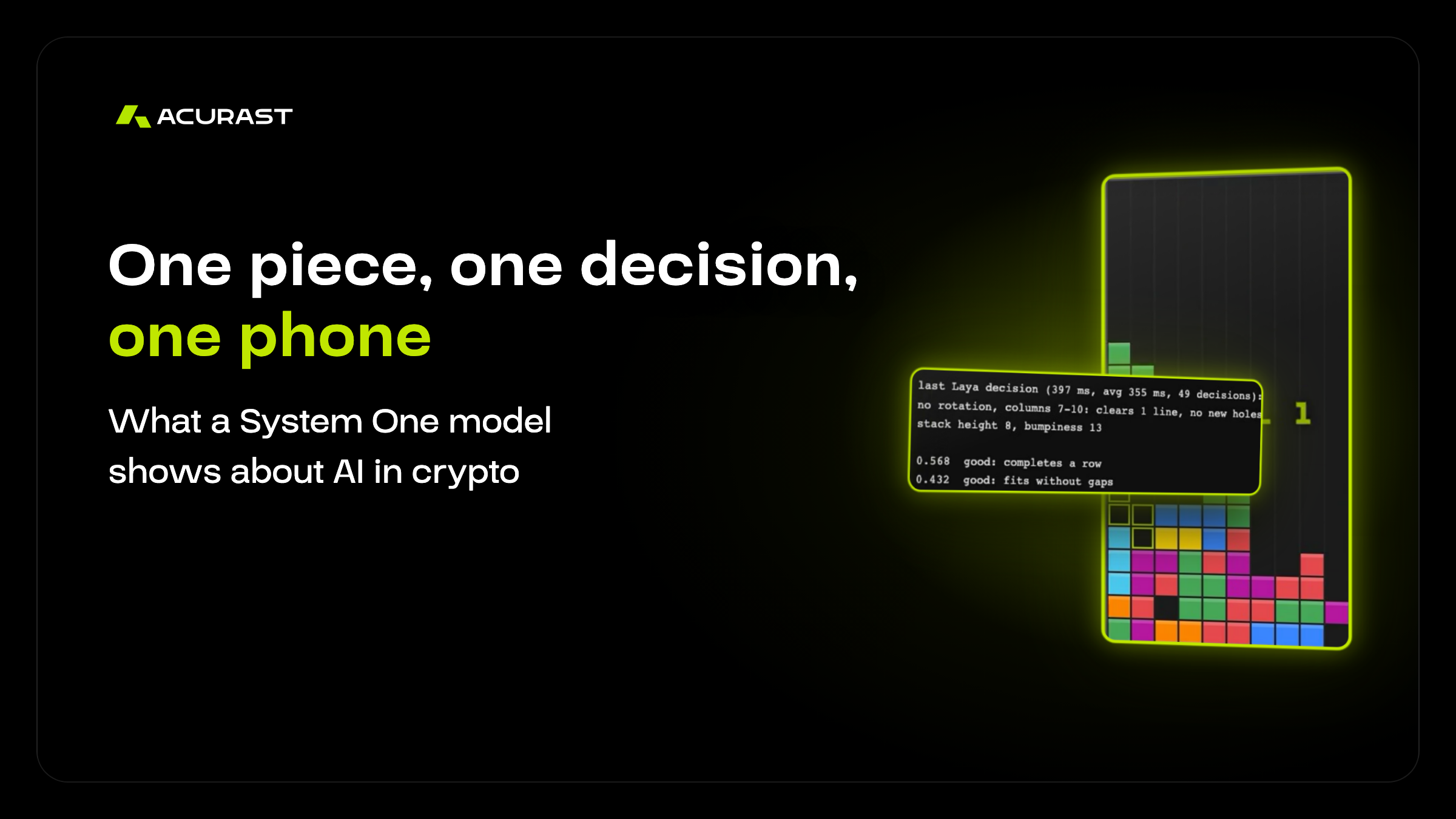
Laya Plays Tetris: One Piece, One Decision, One Phone
Tetris is a game of constant decisions. Every falling piece changes the board, and a placement that looks good now can create problems several moves later.
In Acurast’s latest AI demos, those decisions are made by Laya, an AI System One decision model, running on an Android phone.
Instead of generating text or answering questions, Laya looks at the current game state, evaluates a fixed set of possible moves, and chooses where the next piece should go. The game handles the calculations, the model makes the decision, and a phone does the work.
It is a simple demonstration of a broader idea, and one that matters for AI in crypto: not every question needs in-depth research or reasoning. Sometimes, AI just needs to make a quick decision and choose the right option.
The pattern
One piece, one decision, one phone
Software generates the options. AI makes the decision. A phone does the work.
How Laya Plays
Tetris has a straightforward objective: move and rotate falling pieces to complete horizontal rows. Completed rows disappear, creating more space on the board. Poor placements, however, can leave gaps that make later moves more difficult.
Laya approaches this problem by choosing from a shortlist of five possible placements for each piece. The process works like this:
- Generate the options. The game calculates possible placements for the new piece, accounting for its shape and available rotations, then presents five candidate moves.
- Describe each move. Each option receives a short description of its likely effect, such as completing a row, fitting cleanly, or leaving a gap.
- Provide the context. The current board, the new piece, and the five candidate moves are sent to Laya as a single decision task.
- Choose a move. Laya selects one of the available options and returns a probability for each choice.
- Update the board. The selected move is played, the game state changes, and the process repeats for the next piece.
Laya is an open System One model from ConvAI Innovations. System One models are designed for choosing between predefined options rather than generating open-ended responses.
For Tetris, that makes the interaction relatively simple. The game provides the situation and the available moves; the model decides which move to take.
Where the Pattern Fits in Crypto and AI
Many tasks in crypto involve choosing between several possible actions. Software can calculate routes, simulate transactions, identify eligible hardware, or list permitted operations. The remaining challenge is deciding which option best fits the user’s priorities.
A decision model can help bridge that gap.
Wallet transaction review
Software generates: simulated transaction outcomes and available actions.
The model helps decide: whether an action fits the user’s rules, such as avoiding unlimited token approvals.
Swap routing
Software generates: candidate routes across liquidity pools, including fees and expected slippage.
The model helps decide: which route best matches priorities such as cost, speed, or fewer hops.
Intent and order matching
Software generates: candidate ways to fulfil an order or user intent.
The model helps decide: which option best satisfies the user’s constraints.
On-chain agents
Software generates: a list of permitted next actions.
The model helps decide: which action to take under the owner’s instructions.
DAO governance
Software generates: proposals, summaries, and available voting choices.
The model helps decide: which option aligns with a delegate’s stated voting policy, or whether human review is needed.
Compute job placement
Software generates: eligible phones that meet a job’s hardware and location requirements.
The model helps decide: which phone is the best fit for the job.
The model does not need to perform every calculation itself. It can focus on the decision, using information prepared by the surrounding software.
Four properties make this approach particularly interesting.
1. Decisions can be constrained
The model chooses from a predefined set of options rather than producing an unrestricted action. If the software validates the candidates correctly, this can reduce the risk of selecting an invalid action. In sensitive applications, the chosen action should still pass independent checks before execution.
2. Model scores can support review
Laya returns a probability for each option. These values can help developers understand how the model distributes its choices and design rules for escalating uncertain decisions to a human.
Probabilities are not automatically reliable measures of confidence, however. They need to be evaluated and calibrated before they can safely support automated decision thresholds.
3. The decision process can be lightweight
A compact model running on a phone may be sufficient for structured tasks that do not require a large model or extensive computation. The result is a potential path toward applications that make decisions locally or through distributed infrastructure, rather than relying exclusively on centralized servers.
4. You can shape the decision strategy
Instructions let you influence how Laya chooses, without changing which options are available. You might tell it to keep the stack flat, or to clear rows whenever possible, and get different placements from the same board and candidates.
This separates generating options from choosing among them: the game supplies the candidates, while the instructions shape how they are evaluated. The same idea could apply to a wallet assistant with a conservative transaction policy, a router that prioritizes lower fees, or an agent following rules set by its owner. Results depend on how clearly the policy is expressed, how faithfully the model follows it, and whether the final action is independently validated.
These properties do not eliminate the need for safeguards. They provide a framework for separating candidate generation, decision-making, and execution so that each stage can be tested independently.
“The game supplies the candidates. The instructions shape how they are evaluated. The model picks one.”
Every Move Comes From a Real Phone
The demo also showcases the infrastructure behind the decision-making process.
Each decision is sent through an HTTP request to an Android phone on the Acurast Network. The phone runs Laya on its own CPU and returns a response. According to the demo’s reported timings, decisions typically take around 0.2 to 1 second.
For a turn-based game like Tetris, that is fast enough to keep the experience moving.
5
Candidate moves per piece
0.2–1 s
Per decision, on a phone’s CPU
<1 ACU
Per day to run your own instance
The interface also displays information about the phone serving the request, including its country, processor, and the number of decisions it has handled. A link allows users to check the phone’s on-chain record.
These features make the infrastructure part of the demonstration rather than hiding it behind an ordinary API endpoint. Users can see that a physical phone is participating in the process and explore the associated verification information.
The broader point is that AI inference does not always require a large model running in a centralized data center. For tasks with a limited set of choices and relatively small amounts of context, a compact model running on everyday hardware may be enough.
That does not mean every AI workload is suited to a phone. Larger models and computationally intensive tasks may still require more powerful hardware. The value of the demo is showing one kind of workload that can be handled by a smaller model on distributed phones.
Try It Yourself
The Laya Tetris demo is available at laya.acurast.com, alongside Snake, Doom, and six other demos. No account or sign-up is required.
You can experiment with the game, observe the model’s decisions, and explore how changing its instructions affects its behavior.
Developers can also start their own instance using the Cargo: Laya template in the Acurast Hub playground. Acurast states that a decision model can run on one of more than 320,000 phones for under 1 ACU per day. Actual costs and availability depend on the applicable configuration and network conditions.
The code is available in the Acurast example apps on GitHub.
Building on Acurast? If you’re running your own models, agent backends or decision services on attested phones, the Acurast Discord is where builders compare notes. Join the Discord.
Related Blogs
Author