Why System One Models Belong on a Decentralized Cloud

Much of the AI running in production answers simple questions. Is this email spam? Is the ticket a refund request or a bug report? Is this prompt safe? On September 15, TypeSafe AI launched Jev, a model built only for that kind of question. A week later, an open alternative was out.
This new class is called the System One model, and it happens to be exactly the workload a decentralized cloud handles best. Here is why decisions are where decentralized AI makes the most sense, and what it looks like running on a phone.
The demos are live: try them yourself at laya.acurast.com.
The workload
Decisions, decentralized
Small, stateless and private: the AI that fits on a phone.
What a System One Model Is
Chat AI writes its answer one word at a time. A System One model skips the writing. You give it some text and a few questions with fixed options, and it answers all of them in one go, with a probability for each:
- Pick one: refund, technical help or something else?
- Yes or no: is this urgent?
- Rate it: calm, annoyed or angry?
Nothing to parse, nothing to hallucinate. Jev is the closed version, a paid API that locks every app built on it to one vendor. Laya, from ConvAI Innovations, is the open one: Apache 2.0 licensed, about 800 MB, and compatible with Jev’s API, so an app built for one can switch to the other.
Why System One Models Belong on a Decentralized Cloud
Frontier language models need racks of GPUs, which is why most “decentralized AI” still ends up renting data centers. A System One model is the opposite: small enough for one phone, with no memory between requests, and fed with some of the most private text a company has. That is precisely the shape of work a network of phones is built for.
It Scales Out, Not Up
Data centers scale up: a bigger GPU, a bigger building. Decisions scale out. Every request stands alone, so ten phones do ten times the work, and on Acurast the number of phones is a single setting.
The supply is already there. Around 1.39 billion smartphones are sold every year, and the ones they replace still have perfectly good processors. More than 310,000 phones have already joined Acurast.
310K+
Onboarded phones
1B+
On-chain transactions
0.2 s
Per decision on the fastest phones
Accessible: Deployed From the Browser
No server to rent, only someone else’s phone: the example has a deployment cost of under 1 ACU a day. In the Acurast Hub playground, pick the Cargo: Laya template, choose how many phones, and deploy. A few minutes later, your own decision model is online.
Private: Decisions Touch Your Most Sensitive Data
With a hosted API, every email, chat message and support ticket you classify passes through someone else’s servers. Run your own and that changes. No company sits in the middle, the model’s weights are open, the example app keeps no logs, and it only runs on attested phones, verified as genuine hardware.
Enabled by Cargo
Acurast Cargo gives every Deployment a full Linux environment on the phone, so Laya installs exactly as it would on a rented server. The same runtime already hosts OpenClaw, WordPress and Minecraft servers. AI moves in weeks, and Cargo keeps up.
“When the next model class appears, it doesn’t need a new integration, only a start script from whoever wants to run it.”
See It Run
The test phones used in the example are spread across Europe, the US and Asia. The fastest phones answer a short yes-or-no question in about 0.2 seconds and sort a whole email in well under a second; slower phones take a second or so. That is slower than a data-center GPU, and for email, moderation or agents it doesn’t matter.
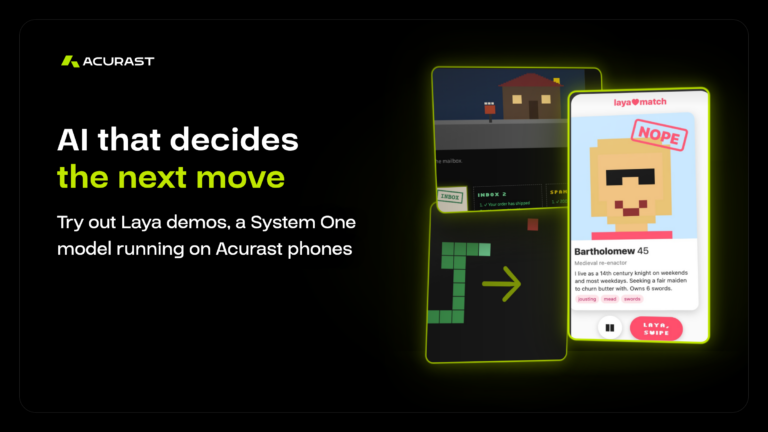
The games show what that speed is for. Laya looks at the board, picks a move, sees what changed and decides again: which way the snake turns, where a Tetris piece lands, and in Doom whether to aim, shoot, pick something up or open a door. The mail sorter and the chat moderator run the same loop; only the options change.
Eleven demos run on Laya, now including Doom: a mail sorter, a live chat moderator, a newsroom that spots clickbait, a prompt injection guard, a dating app, Snake, Tetris and more. Try them live at laya.acurast.com.
Where It Falls Short
System One models are a week old as a category, and Laya has real limits. Accuracy drops once a question has more than about 20 options, the base model is overconfident until it is calibrated, and tricky or adversarial text still fools it. Treat it as a fast first filter, not the final word.
Deploy Your Own
There is no waiting list and no provider to ask for API access. Open the Hub playground, choose Cargo: Laya and deploy. The code, including all eleven demos, is open in the Acurast example apps on GitHub.
Building on Acurast? If you’re running your own models, agent backends or decision services on attested phones, the Acurast Discord is where builders compare notes. Join the Discord.
Related Blogs
Author