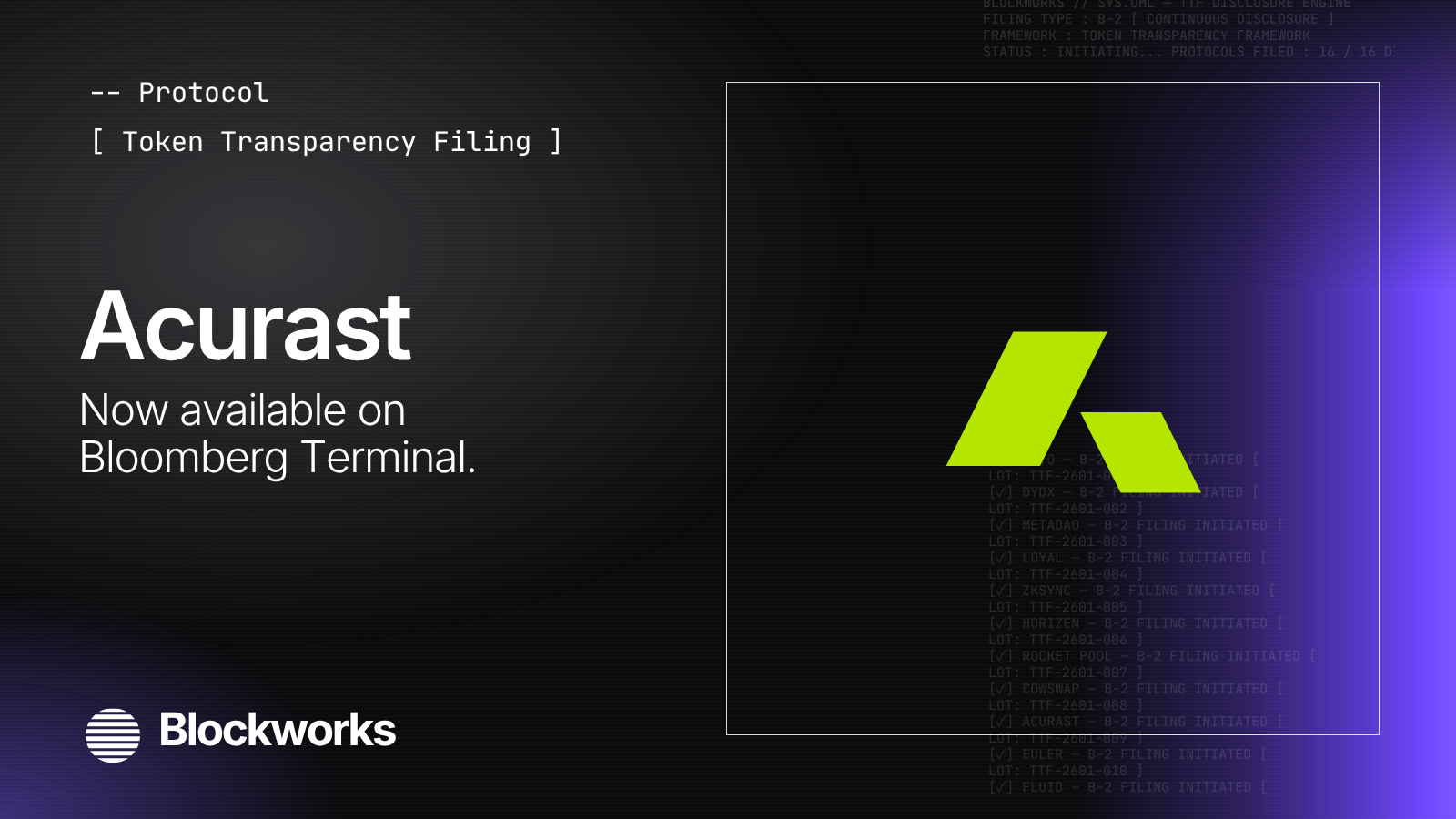
Radical Transparency: Why Acurast Published Its ACU Token Transparency Filing
Acurast is built around a simple principle: don’t trust, verify.
Acurast’s decentralized compute network replaces centralized data centers with a globally distributed network of dedicated phones and Trusted Execution Environments (TEEs). Computation can be executed confidentially and verified at the hardware level.
The same principle is applied across the economic and Governance layers of the protocol.
Token allocation, vesting, governance rights, and administrative controls are as important to understanding a protocol as its code and infrastructure. These details should be available for independent review.
For this reason, Acurast submitted the ACU token to the Blockworks Token Transparency Framework.
Why Token Transparency Matters
Token disclosures are often spread across documentation, governance proposals, legal entities, and third-party platforms. This makes it difficult to establish a complete view of token ownership, distribution, vesting, governance, and administrative authority.
The Blockworks Token Transparency Framework standardizes these disclosures in a single filing.
Acurast’s filing covers the structure of ACU, including token allocations, vesting and unlock schedules, governance mechanisms, and administrative controls.
Governance and Administrative Controls
A key part of the filing is the distinction between on-chain governance and administrative authority.
Acurast uses protocol native OpenGov for protocol Governance. ACU holders can participate in Governance through conviction voting, which allows participants to commit tokens for longer periods to increase their voting power.
The filing also documents the absence of privileged multisigs or administrative backdoors capable of bypassing on-chain Governance.
The Acurast Association or any other party outside of Governance does not hold special administrative keys that allow it to unilaterally:
- Modify runtime parameters
- Alter token balances
- Redirect network rewards
These controls define how authority is distributed and how protocol changes are made.
ACU Token Economics
The filing provides details on ACU allocation, vesting, and unlock schedules and provides insights how ACU is used within the Acurast ecosystem for functions including:
- Network fees
- Compute provider incentives
- Staking
- Governance
The disclosures provide a clearer view of the relationship between the token and the operation of the protocol.
The Infrastructure Behind Acurast
Acurast operates a distributed physical compute network with more than 313,000+ dedicated phones onboarded globally.
This compute powers mission-critical workloads with high-security and AI requirements – from REST APIs and webhooks to LLM inference and confidential data processing. Providing an alternative to cloud infrastructure concentrated among providers such as AWS, Google Cloud, and Microsoft Azure.
Transparency Across the Protocol
A protocol cannot be fully evaluated through its code alone.
Infrastructure, governance, token economics, and administrative permissions all determine how a system operates and who can influence it.
Publishing the ACU Token Transparency Filing puts these details into a standardized disclosure that can be reviewed independently.
This is the practical application of Acurast’s principle:
Don’t trust. Verify.
Explore the Filing
Read the complete Acurast disclosure through the Blockworks Token Transparency Framework:
View the Acurast Filing on Blockworks Token Transparency
Related Blogs
Author